Types of LGBTQ+ Identities: Complete Guide to Gender & Sexuality
If the growing list of letters in "LGBTQ+" has ever left you a bit confused, you're definitely not alone. The acronym keeps growing because people are more varied than a handful of labels can capture — and most of these words exist because someone needed language that actually fit how they feel. If you want the acronym itself broken down letter by letter first, our guide to what LGBTQ+ stands for is a good place to start.
This guide walks through the types of LGBTQ+ identities you'll hear most often, and it's organized the way they actually work: sexual orientation, gender identity, and gender expression are three separate things, even though people mix them up all the time. Once that difference clicks, the rest of the acronym gets a lot easier to follow.
Three Things People Often Mix Up
Before we get into definitions, it's worth separating three ideas that tend to get lumped together:
- Sexual orientation is about who you're attracted to — romantically, emotionally, or sexually.
- Gender identity is about who you know yourself to be, regardless of what you were assigned at birth.
- Gender expression is how you show that on the outside — through clothes, mannerisms, how you carry yourself.
Here's the thing: none of these decide the other two. A transgender woman can be straight, gay, bisexual, or anything else — being transgender is about her gender, not who she's attracted to. Keep these three separate in your head and everything else in this guide will make a lot more sense.
So What Does LGBTQ+ Actually Stand For?
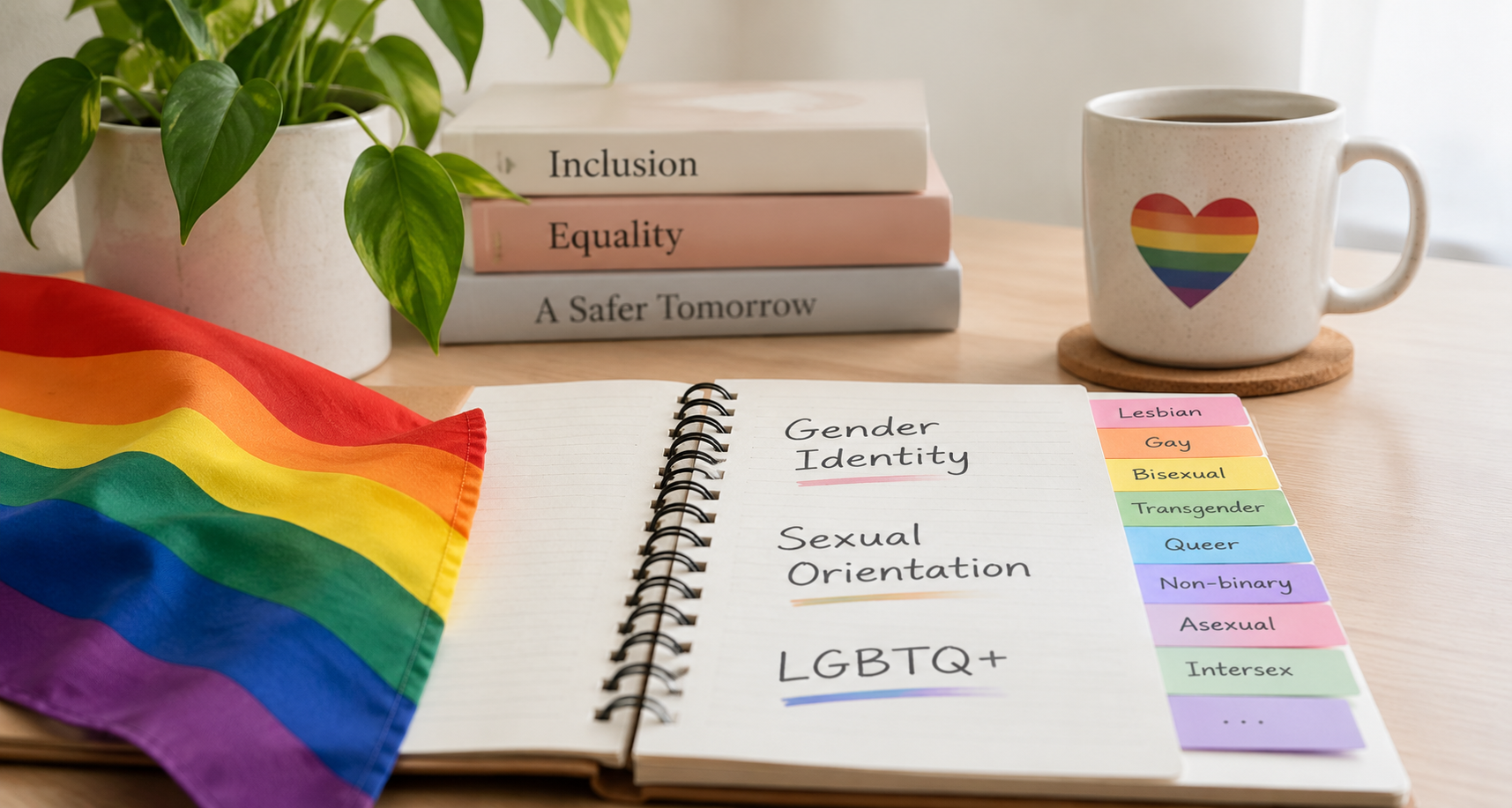
LGBTQ+ stands for Lesbian, Gay, Bisexual, Transgender, and Queer or Questioning. The plus sign is doing a lot of work — it stands in for all the other LGBTQ+ identities that don't fit neatly into those five letters. You'll also run into longer versions like LGBTQIA+ (which adds Intersex and Asexual) or LGBTQIA2S+ (which includes Two-Spirit, a term specific to some Indigenous communities).
None of these acronyms are set in stone. Language keeps changing as people find better words for what they're actually experiencing — so think of this as a snapshot of where things stand today, not a final answer.
Identities Based on Who You're Attracted To
A lot of these sexual orientation identities have their own pride flag too — if you've spotted one you didn't recognize, our guide to LGBTQ+ flags breaks down what each one means.
Gay
Usually describes a man attracted to other men, though plenty of women and non-binary people use gay too, to describe attraction to their own gender. It's one of the oldest, most recognized words in this whole vocabulary.
Lesbian
A woman attracted to other women, romantically, emotionally, or sexually. Some women say "gay" instead of lesbian — both are fine, and following what someone calls themselves is always the safest bet.
Bisexual
Attraction to more than one gender. That doesn't mean equal attraction to everyone, and it's not a stopover on the way to somewhere else — bisexual is its own stable orientation, and it looks different from person to person.
Pansexual
Attraction to people regardless of their gender. If bisexuality is often described as "more than one gender," pansexual is usually described as "gender isn't really the factor." A lot of people use "bi" and "pan" almost interchangeably, and how much the distinction matters really depends on the person.
Asexual
Little to no sexual attraction to others. It's a spectrum — some asexual people still want romantic relationships, others don't experience romantic attraction either (that's sometimes called aromantic, more on that below). And to be clear, asexuality is about attraction, not about whether someone wants to have sex — those are two different questions.
Queer
This word started as a slur, and a lot of the LGBTQ+ community has since reclaimed queer as a general umbrella term — for any orientation or identity that isn't straight or cisgender. Some people wear it proudly as their own label. Others still find it uncomfortable given its history. Again: follow their lead, not a rulebook.
Questioning
Someone who's actively figuring out their orientation or gender identity. Being questioning isn't a waiting room before the "real" answer arrives — for a lot of people, it just is where they are, and that's completely okay.
Identities Based on Gender
Transgender
Someone whose gender doesn't match the sex they were assigned at birth. A transgender man was assigned female at birth and knows himself to be a man; a transgender woman was assigned male and knows herself to be a woman. "Trans" works as shorthand, and it's worth remembering it's a describing word, not a noun — "a transgender person," never "a transgender."
Cisgender
The flip side of transgender — someone whose gender matches what they were assigned at birth. Most people are cisgender, which is exactly why you don't hear the word much. But naming it matters: without it, "cisgender" quietly becomes "normal" by default, and transgender ends up looking like the only identity that needs an explanation.
Non-Binary
An umbrella term for anyone whose gender doesn't fit neatly into "man" or "woman." Some non-binary people feel like a bit of both, some feel like neither, some experience gender in a way that doesn't map onto that scale at all. Pronouns vary person to person — they/them, he/him, she/her, or some mix. If you're not sure how to use someone's pronouns respectfully, our pronoun guide walks through it.
Genderfluid
A gender identity that shifts — someone might feel more masculine one day, more feminine another, or neither on a given day. Genderfluid sits under the non-binary umbrella, but it's specifically about movement rather than one fixed identity.
Agender
Someone who doesn't identify with any gender at all. For agender people, gender might simply not apply to them, or they experience themselves entirely outside that framework.
Genderqueer
Closely related to non-binary — describes identities and expressions that go beyond the usual man/woman categories. Some people use genderqueer and "non-binary" to mean the same thing; others see a personal difference between them.
Two-Spirit
A term that belongs specifically to some Indigenous North American cultures, describing someone who carries both masculine and feminine spirit. Two-Spirit is a cultural and spiritual identity, not a general stand-in for "non-binary" — and it's not a term for non-Indigenous people to take on for themselves.
A Few More Terms Worth Knowing
Intersex
Describes someone born with physical sex characteristics — genitals, chromosomes, hormones — that don't fit typical definitions of male or female. Intersex is a physical trait, separate from gender identity or orientation. Intersex people can be gay, straight, bisexual, transgender, or anything else.
Demisexual
Someone who only feels sexual attraction after building a real emotional connection with someone. Demisexual is usually understood as part of the asexual spectrum, since attraction doesn't switch on right away the way it might for other people.
Aromantic
Little to no romantic attraction to others. Aromantic people can still want sex, still build deep friendships, still want long-term partnerships — it's specifically romance that's missing from the picture, not connection in general.
Ally
Not an LGBTQ+ identity itself — it describes someone outside the community who shows up for it anyway. Being an ally isn't a badge you earn once; it's more of an ongoing habit than a label.
Why Any of This Actually Matters
This isn't about memorizing a glossary for the sake of it. Getting these distinctions right changes how people get treated. A doctor who understands gender identity and sexual orientation are separate questions asks better, less invasive ones. A friend who knows "questioning" isn't a phase to rush through offers better support. A workplace that understands "transgender" is about identity, not attraction, skips an entirely unnecessary and inappropriate conversation.
Language around LGBTQ+ identities keeps changing — and that's not a problem, it's a sign that people keep finding more precise words for their own experience. You don't need to have every term memorized. You just need enough curiosity to ask instead of assume, and enough respect to use the words people actually choose for themselves. For more on why that kind of language matters for feeling like you belong somewhere, see why LGBTQ+ community matters and how to find one.
Frequently Asked Questions
What's the difference between sexual orientation and gender identity? Sexual orientation is about who you're attracted to. Gender identity is about who you are. Knowing one tells you nothing about the other — they're completely separate.
Is "queer" an offensive word? Depends on who's saying it and how. Plenty of LGBTQ+ people have reclaimed it as their own identity and as a general umbrella term. Others still associate it with its history as a slur. Safest move: use whatever word the person uses for themselves.
What does the "+" in LGBTQ+ actually mean? It covers every orientation and gender identity beyond lesbian, gay, bisexual, transgender, and queer/questioning — pansexual, asexual, intersex, non-binary, and everything else in this guide.
Can someone's gender or orientation change over time? For some people, yes. Identity isn't always something you're handed at birth and done with — understanding yourself can be an ongoing process, not a single lightbulb moment.
How do I figure out which term fits me? There's no quiz for this. If something in this guide feels like it describes you, that's reason enough to sit with it — and you're never required to land on a label at all if you're not ready to.
Looking for people who already understand all of this? AffirmSpace is where you can start.

💬 Community Thoughts
No comments yet