
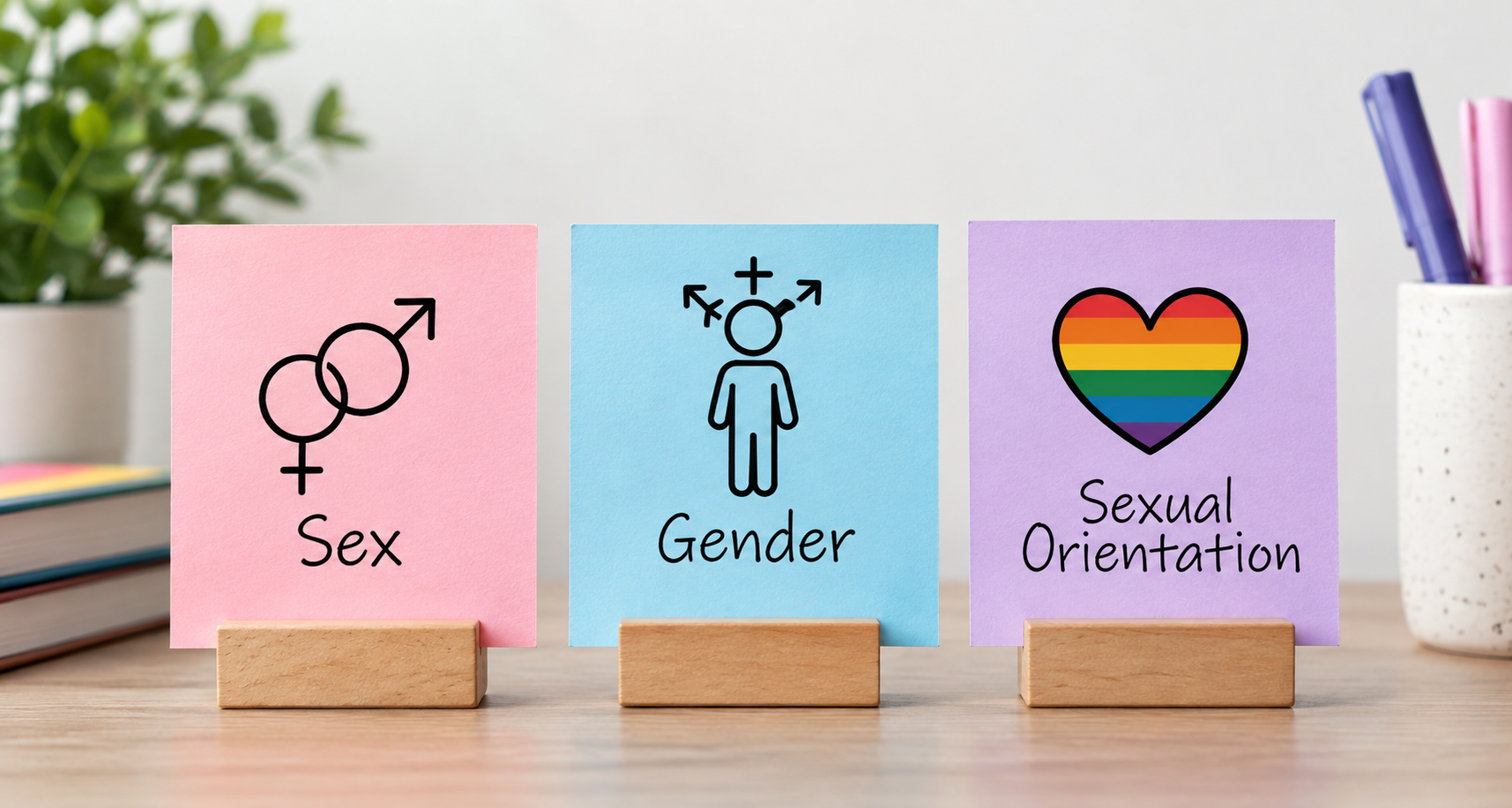
Sex vs. Gender vs. Sexual Orientation: What's the Difference?
People often use "sex," "gender," and "sexual orientation" as if they mean the same thing. They don't. Mixing them up is the most common reason conversations about LGBTQ+ topics get confusing. Here's a simple breakdown, plus a fourth idea, gender expression, that's usually missing from the conversation.
The Quick Version
- Sex is about biology: the physical characteristics a person is born with.
- Gender is about identity: who a person knows themselves to be.
- Gender expression is about presentation: how a person shows their gender.
- Sexual orientation is about attraction: who a person is drawn to.
None of these decides the others.
What Is Sex?
Sex usually refers to the physical traits used to categorize bodies, such as chromosomes, hormones, and reproductive anatomy. At birth, most babies are labeled male or female based on their anatomy. That's often called sex assigned at birth.
Biology is more varied than two boxes, though. Intersex people are born with physical characteristics that don't fit typical definitions of male or female. Intersex is a body variation. It's separate from gender identity and sexual orientation.
What Is Gender?
Gender is a person's internal sense of who they are, such as a man, a woman, both, neither, or something else. It's also shaped by social ideas about what's "masculine" or "feminine," which vary between cultures and change over time.
For many people, gender identity matches the sex they were assigned at birth. Those people are cisgender. For others it doesn't. Transgender people have a gender identity that differs from their sex assigned at birth, and non-binary people have a gender identity that isn't only "man" or "woman."
What Is Gender Expression?
Gender expression is how someone shows their gender outwardly, through clothes, hair, voice, name, and mannerisms. It's not the same as gender identity. Someone can express themselves in a way that's traditionally masculine, feminine, both, or neither, regardless of their identity. We go deeper in our guide to gender expression.
What Is Sexual Orientation?
Sexual orientation describes who someone is attracted to, romantically, emotionally, or sexually. Common orientations include gay, lesbian, bisexual, pansexual, asexual, and straight. Orientation is about attraction, and it's separate from how someone identifies or dresses.
Why They're Separate: A Few Examples
- A transgender woman might be attracted to men, women, both, or neither. Being transgender describes her gender, not her orientation.
- A man who wears makeup isn't necessarily gay or transgender. His expression doesn't tell you his identity or orientation.
- A cisgender woman can be straight, lesbian, bisexual, or asexual. Her gender and attraction are independent.
- An intersex person can be a man, a woman, non-binary, gay, straight, or anything else.
Common Mix-Ups
- "Gay people want to be the opposite gender." No. Orientation isn't about gender identity.
- "Transgender people are attracted to the same gender." Not necessarily. Trans people have every orientation, just like everyone else.
- "You can tell by how someone looks." You can't. Expression doesn't reveal identity or orientation.
Why the Difference Matters
Getting these straight helps conversations go better. Doctors can ask the right questions. Friends can offer better support. And people can describe themselves with more accuracy, because the right words make it easier to feel understood. If you want to see how these ideas connect to specific identities, our complete guide to LGBTQ+ identities walks through them.
Frequently Asked Questions
What's the difference between sex and gender?
Sex refers to physical characteristics, like anatomy and chromosomes. Gender refers to a person's internal sense of who they are, plus social ideas about masculinity and femininity.
Is sexual orientation the same as gender identity?
No. Orientation is about who you're attracted to. Gender identity is about who you are. Knowing one doesn't tell you the other.
What is sex assigned at birth?
It's the label, usually male or female, given to a baby based on physical characteristics at birth.
Can someone be transgender and gay?
Yes. Being transgender is about gender identity, and being gay is about attraction. People can be transgender and have any sexual orientation.
Want to talk with people who already understand the difference? AffirmSpace is a good place to start.

💬 Community Thoughts
No comments yet